Showing posts with label Eco-macro intro text. Show all posts

Sunday, September 29, 2013

I.7: Money

(from the larger project of an introductory approach to Ecological macroeconomics)

No video for this chapter, at least not yet.

But there is a pull quote:
Money, in its pure form, is like chicken for a vegan, in a world where everyone is a vegan.
Here's the text:

CHAPTER 7: MONEY

With money, we move solidly into the realm where there aren’t directly analogous phenomena in other species or in ecosystems as a whole. The task is the same: there’s still a need to coordinate the actions of multiple individuals within a species, or to mesh the roles of multiple species within an ecosystem. But money as a tool for doing that is a uniquely human approach, with unique attributes.

And yet, to understand it we’re going to start by going back to those pre-human models. Because when we look at money’s role in the context of how ecosystems coordinate their activities, we do two things. First, we shed a particular light on how money works. And second, we develop a way of seeing when money doesn’t work so well.

Animal use value
Use value for humans
Exchange value
Value added
Distributing use value
Money
- What money is
- Roles of money
- Attributes of money
The value spectrum

Animal use value
Start with a familiar picture, one of the stylized versions of an ecosystem from chapter 2. [See Figure I.7.1 below.] The ecosystem is full of species that are doing things that keep the whole thing humming along nicely. But that’s not “why” they’re doing it.

As an example, look at soil organisms decomposing dead stuff that used to be living. If we had to translate the instructions in their genetic code and accompany those instructions with a rationale, their genes wouldn’t be telling them, “Break down that organic matter and make it available to plants for new growth so that everyone in the neighborhood can thrive.” No. Their genetic instructions are, “Eat that, because it’s got energy or other stuff you need in order for you to live.”

That other thing gets done: the soil organisms break stuff down and make it available for plants. But from the organism’s perspective, that’s not why it’s doing it. It’s merely doing what’s useful for its survival. The seemingly magic part is that a coevolutionary process has shaped it such that, when it does what’s good for its own survival, it’s also doing what’s good for the ecosystem.

From an animal’s perspective, the “value” of anything it does is based on how much that thing contributes to the survival of its genes. Animals are shaped by evolution such that behaviors they find useful—behaviors they choose to engage in, behaviors that have “use value” to them—are also behaviors that increase the chance of their genes making it into the next generation and beyond.

Saturday, September 21, 2013

I.6: Social evolution of the economy

This one starts from the observation that living in groups is really useful, then looks at the different mechanisms humans have used to coordinate that cohabitation, starting with norms and progressing through money and credit.

Video here.

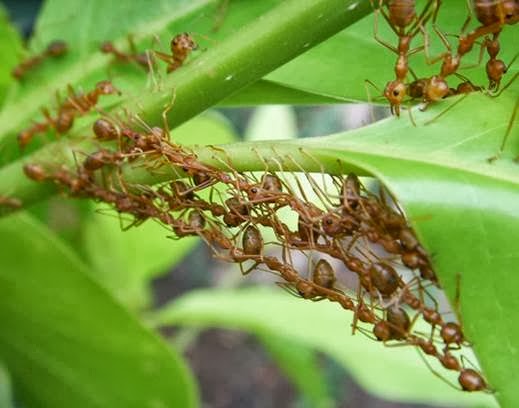
http://papasez.hubpages.com/hub/Weaver-ants-predation-and-natural-control

Thursday, September 19, 2013

Saturday, September 14, 2013

I.4: The physical structure of the economy

As with chapter 3, this one is in two parts:
Part a
Part b

We finally make the jump from just looking at ecosystems, to using ecosystems as an aid in understanding how an economy is put together.

Thursday, September 12, 2013

I.3: Complex adaptive systems

Here's chapter 3, broken into two parts (for length--the total is about 16 minutes):
Part a
Part b

This is about how ecosystems are self-organizing systems that adapt themselves to changing circumstances. It's the last chapter before we get into economies.

Saturday, September 7, 2013

I.2: Ecosystems - energy and matter

This is chapter 2 of the introductory macroeconomics course.

It lays out the parts of how ecosystems work that will be useful in understanding how an economy works.


CHAPTER 2: ECOSYSTEMS - FLOWS OF ENERGY AND MATTER
The previous chapter made the case for an economy having some important similarities to an ecosystem, and for resources and the environment playing a fundamental role in macroeconomics.

Every economic process uses resources in one way or another, and economic change can even be defined as a change in the way resources are used.

The next step is to study how ecosystems work. This may seem like an odd move in an economics course, but there are two reasons for doing it.

The first is that ecosystems are in some ways simpler than economies. The extra complications of economies have to do with the social tools humans create, which we’ll start getting into in chapter 6. But their role will be easier to understand if we start without them.

The other consideration is that there’s a long history of people studying ecosystems as ecosystems, and not so much of looking at economies that way, so we’re going to poach off of knowledge gained in other fields.

Chapter overview
  • 1st and 2nd Laws of Thermodynamics
  • Energy storage and gradients
  • Functions and structures in ecosystems
  • Circulation of matter vs. pass-through of energy

Wednesday, September 4, 2013

I.1: Economies, resources, ecology

(from the larger project of an introductory approach to Ecological macroeconomics)
Here's a video version of Part I, Chapter 1 of my macroeconomics course, setting the economy in a physical context.

(There's an unfortunate pause about halfway through.)

CHAPTER 1: ECONOMIES RESOURCES, ECOLOGY

What does an ecosystem have to do with an economy?
 
There’s a pair of straightforward answers—they may even have occurred to you. For one thing, the economy gets some important inputs from ecosystems: trees, fish, clean water, just to name a few.
 

Going the other direction, when the economy harvests trees, or pollutes, or lays down pavement, that affects ecosystems.
 
These answers aren’t wrong, but there’s another one that goes a bit deeper. That’s the idea that an economy is itself kind of like an ecosystem, or that economies and ecosystems are two instances of the same sort of thing.